
KMS Activators, Are They Malware?
Since a few weeks, new waves of infection related to the use of hacktools like Windows Loader or KMSPico caught our attention (KMS Activators). Since they are more used than before some malware authors now use them to disseminate infections.
KMS ACTIVATORS: BYPASSING ACTIVATION
With the release of Windows 10, illegal MAK and SLP activations became really difficult to perform and thus, available hacktools now use KMS.
Key Management Service (KMS) is used to activate Microsoft products on clients using generic keys against a Volume Activation Service, hosted on a remote server. Legally owned volume licenses are installed on the server and activation is required typically every 180 days to keep the products activated on client machines.
For more information, please refer to the Understanding KMS article by Microsoft.
Hacktools using KMS activation emulate a fake KMS server on the local computer and trick Microsoft products to activate against it. Products activated this way have temporary valid license and when installing such hacktools, a task is often created to automatically renew it every 60 days.
WHY NOT USING THEM?
Aside for the ethical point of view and TOS breaking, using hacktools may put your computer at risk. Even if some of them are perfectly functional and malware-free, that’s not a generality.
We have tested the first KMS activators returned by Google search engine and analyzed them. Here are the results :
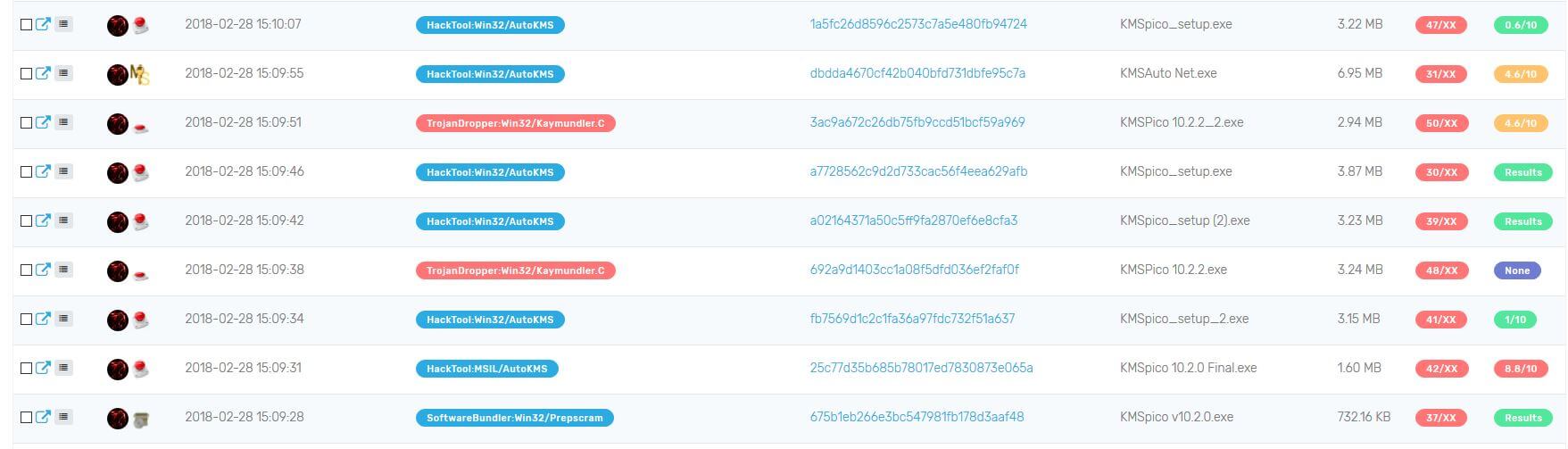
Most of them are highly detected on VirusTotal, and a lot of them have suspicious activity in sandbox analysis.
Sample #1 : DBDDA4670CF42B040BFD731DBFE95C7A
Interesting characteristicsSuspicious/Malicious activitiesCheck for debugger and virtual environment
Signed using an unrecognized root certificateNone (program crashed)
Sample #2 – 692A9D1403CC1A08F5DFD036EF2FAF0F
Interesting characteristicsSuspicious/Malicious activitiesCheck for debuggerInstall a backdoor allowing remote access
Browser redirections and adclickers
Monero cryptomining
Sample #3 – 3AC9A672C26DB75FB9CCD51BCF59A969
Interesting characteristicsSuspicious/Malicious activitiesCheck for debuggerBrowser redirections and adclickers
Monero cryptomining
Sample #4 – 675B1EB266E3BC547981FB178D3AAF48
Interesting characteristicsSuspicious/Malicious activitiesCheck for debugger and virtual environmentOpen a backdoor allowing remote access
Sample #5 – A02164371A50C5FF9FA2870EF6E8CFA3
Interesting characteristicsSuspicious/Malicious activitiesSigned using an unrecognized root certificateNone
Sample #6 – A7728562C9D2D733CAC56F4EEA629AFB
Interesting characteristicsSuspicious/Malicious activitiesSigned using an unrecognized root certificateChange security-related services and parameters
Sample #7 – FB7569D1C2C1FA36A97FDC732F51A637
Interesting characteristicsSuspicious/Malicious activitiesCheck for debugger and virtual environment
Signed using an invalid certificateContact remote machine
Sample #8 – 1A5FC26D8596C2573C7A5E480FB94724
Interesting characteristicsSuspicious/Malicious activitiesCheck for virtual environment
Signed using an unrecognized root certificateContact remote machine
Sample #9 – 25C77D35B685B78017ED7830873E065A
Interesting characteristicsSuspicious/Malicious activitiesCheck for virtual environmentNone
DETECTION & REMOVAL
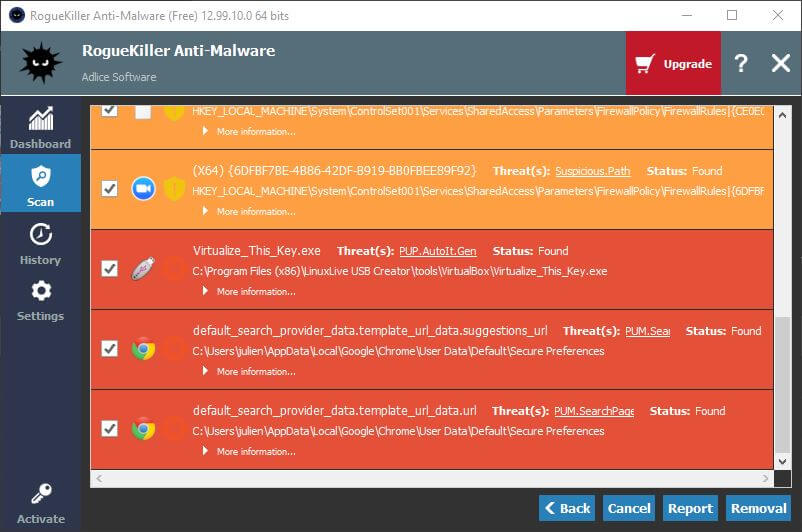
In case you have installed one of these malware variants of KMSpico, and want to make sure they are not doing harmful actions to your machine, can you try to run a scan with RogueKiller Anti-Malware and remove all detections.
CONCLUSION
Some worked as advertised, some crashed on startup or failed to successfully activate Windows. But some included malicious code that would have allowed attackers to access your computer system and data if you happened to run them.
So, even if it is tempting to use such tools to save money, the financial loss resulting of identity or data theft could be much more expensive than the amount to be paid to buy a legal Microsoft license.